BotW: Two species of Lachnophorini

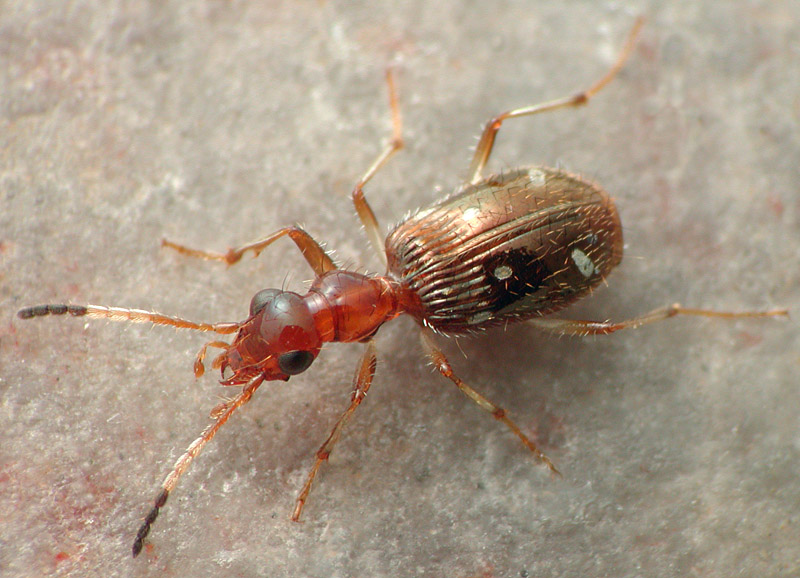
Because I have been remiss at blogging about beetles recently, today I’ll post two Beetles of the Week.  Both are members of the carabid tribe Lachnophorini. The first is a member of the genus Calybe, which are elegant, ant-like species that live on sand or silt shores of bodies of water (rivers, lakes). I found the Calybe sallei, below, in Texas.

Calybe sallei

Calybe sallei

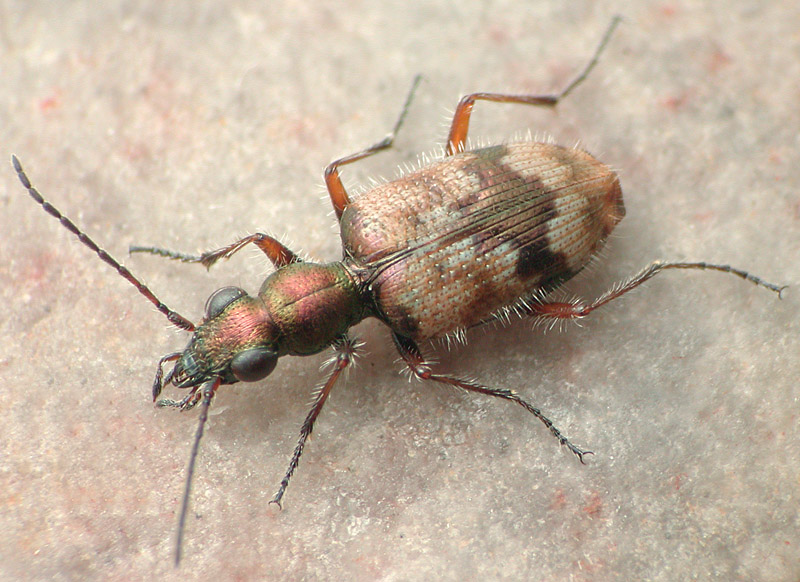
The second is Lachnophorus elegantulus, a common species on gravel river shores in the Southwestern USA and neighboring Mexico.

Lachnophorus elegantulus

Lachnophorus elegantulus

Posted in Beetle of the Week | Tagged | 2 Comments

Where have all the left parentheses gone?

Today is another day in which I am curmudgeon regarding grammar.

Why, oh why, is it deemed acceptable by so many to have forlorn, partnerless right parentheses?  I am referring in particular to the common practice of presenting a numbered list in which each number is followed by a “)”, as follows:

The items are: 1) first item, 2) another item, and 3) a third item.

Argh!  If the numbers are parenthetical remarks (as they often are), then they should be treated like parenthetical remarks in other contexts, i.e., with two parentheses:

The items are: (1) first item, (2) another item, and (3) a third item.

One could use commas, although that gets a bit confusing:

The items are: 1, first item, 2, another item, and, 3,  a third item.

There are some contexts in which one might want only one punctuation mark following the number, and none before.  There are punctuation marks designed for being singletons, and punctuation marks that are intended to be used alone should be used when only one is desired.  For example, instead of

The items are:
1) first item
2) another item
3) a third item

one could simply use colons or periods:

The items are:
1. first item
2. another item
3. a third item

Why one would want to use one half of a pair of parentheses in this context is beyond me.  Why force a new and rather different use on a punctuation mark when there are other perfectly good punctuation marks that are built for the job?  Whenever I encounter unmatched right parentheses I feel as if I somehow neglected to notice the left parentheses that preceded them. Parentheses are meant to be in pairs.

As you might expect, paired parentheses is another one of those language requirements I inflict upon my graduate students.

I am reminded of this relevant xkcd comic.

Posted in Language | 5 Comments

BotW: Bembidion bowditchii

Bembidion bowditchii

Bembidion bowditchii

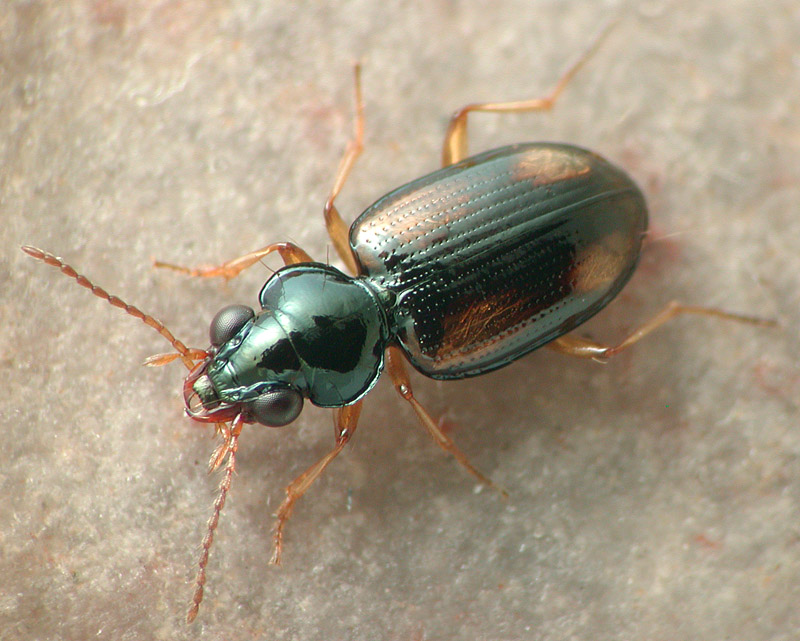
The beetle of the week is a very elegant species, Bembidion bowditchii, which lives in western North America.  It is rarely caught, but not uncommon in the right habitats: broad sandy shorelines of rivers.  It is abundant on the Kootenay River near Bull River in British Columbia, and along the Nooksack River near Deming in Washington.  Here’s the habitat along the Kootenay River:

Continue reading

Posted in Beetle of the Week | Tagged , , | Leave a comment

Drawing beetles

Bembidion alaskense, copyright David R. Maddison, CC-BY-NC

Mixed media drawing of Bembidion alaskense, copyright David R. Maddison, CC-BY-NC

I love the sculptural details of beetles, and their intricate structures and colors.  I like to draw them, although admittedly I haven’t done it much over the past 35 years.  I did the drawing above in 1981, which is a shockingly long time ago, while I was a grad student at the University of Alberta.  I still draw on occasion (my most recent full-color, large drawing was in 2006).  I’ve been asked multiple times what methods I use, and so here’s a brief description, with pictures showing the development of the drawing shown above.

Continue reading

Posted in Scientific Illustrations | Tagged , , , | 10 Comments

Photography of beetle microsculpture

Here’s the setup I use to photograph microsculpture of beetles.  I also use the same setup to photograph whole beetles, or other parts, including genitalia, although there is some variation in lighting, position, etc., depending upon the part.  In some other post I will show how I photograph beetle genitalia using this setup.

The setup is for the most part the one I purchased from GT Vision in about 2006, with a few slight modifications (lighting, software).  It looks like this:

Z6overview1200

On the left is the specimen on a stage, lighting, the lens, and camera; on the right is the computer into which the camera outputs its digital signals.  Here are the details:

Continue reading

Posted in Revising Bembidiina, Scientific Illustrations, Taxonomic Process | Tagged | 1 Comment

Julia’s brilliant idea

My daughter Julia came up with a brilliant idea: partial birthdays by relatedness.  It goes like this.  Say your birthday is on 1 January.  On that day, you have a birthday.  Imagine your daughter’s birthday is 1 June.  On that day, you have a half-birthday, because your daughter shares half of your genes, because she got from you half of your genes.  The implications of this idea of partial birthdays are staggering.

What this means is that today, my daughter’s birthday, I have a half birthday, and as a result, I think I will go out and celebrate.  I don’t know if anyone is going to give me half-presents, but I can certainly hope.

But it gets better.  Each of my first cousins has 12.5% of my genes by direct descent.  Thus, on one of my first cousin’s birthday’s, I have a 0.125 birthday.  One could carry this on to an extreme, and note that as every human shares at least a bit of my DNA by descent, that means every day of the year is a partial birthday for me!  And for you!

And, at least for me, it gets even better, as I have an identical twin.  That means that on my birthday, I have a 2.0 birthday! A double birthday! (Actually, it would be more than a 2.0 birthday, as there would be all those other people in the world with the same birthday to whom I am at least a little bit related.)  And, it means I get 0.5 birthdays on the birthdays of each of his children!   I can see many celebrations in the year ahead…

Posted in fun stuff, Miscellany | Tagged , | Leave a comment

Sculpture on a very small scale

If one looks up close onto the back of a carabid beetle, one will see (in most species) very fine, engraved lines which form a pattern, usually looking like honeycombs, or bricks, or long, thin parallel lines.  This is called “microsculpture”, and is, for reasons that are unclear, relatively constant within a species, and frequently different between closely related species. Here’s what it looks like on the elytron of a female of Lionepha chintimini (Lionepha is a genus closely related to Bembidion):

Lionepha chintimini female, elytral microsculpture

Lionepha chintimini female, elytral microsculpture

You can see the nearly circular little polygons (sometimes called sculpticells) that make up the mesh of the microsculpture. The black bar at the left provides a scale: it is one tenth of a millimeter long.  The beetle as a whole is about 4 mm long. The picture above is a closeup of the same part of the beetle marked by the little yellow box in this image of a male L. chintimini:

Continue reading

Posted in Revising Bembidiina | Tagged , , , | Leave a comment

BotW: Bembidion poculare

Bembidion poculare

Bembidion poculare

This Bembidion is common in oak woodlands in southern Arizona.  It is not directly associated with a body of water (which is unusual for a Bembidion), instead living between oaks and mesquite trees where the soil is slightly damp (perhaps in a valley, above a river bank) and there is some leaf litter on the ground.  For example, it is common in Walker Canyon, the same locality that is pictured in the post on Chlaenius pimalicus.

B. poculare is a member of subgenus Cyclolopha.  A very closely related subgenus, the subgenus Bembidion itself, has several species that live in similarly open, dry environments.

Posted in Beetle of the Week | Tagged | Leave a comment

Terminology

When I was a Master’s degree student at the University of Alberta, in Edmonton, my mentor (George Ball) had a list of requirements for word use in theses.  He also included in this list reasons for each requirement.  George’s thoughts on these matters make sense, and I have absorbed some of these into my own list, which I now inflict upon my graduate students.

One of these is:  use “-ology” words appropriately. One might think to say “Be careful of the terminology you use”, but that in itself represents the same mistake. (“Terminology” is the study of terms, not the terms themselves.  So, let’s be careful of the terms we use.) In biology, the most frequent misuse of “-ology” words is to use them as if they referred to properties of organisms.

Continue reading

Posted in Language | 5 Comments

Save Olea europaea

Every once in a while I will post something that tickles me, even if it has nothing to do with beetles, scientific illustration, systematics in general, or academia.  Today’s the first of these posts.

I came across a sign in Oregon that seems ripe for an amusing edit.  Here’s the sign:

saveLives

Of course, this is a very serious sign, and it should be.  Driving while impaired is a horrific thing to do.  And so it is with some hesitation that I show an alternative version, which popped to mind the moment I saw the martini glass on the sign:

saveOlives

Posted in fun stuff | 2 Comments