BotW: Chlaenius pimalicus

Chlaenius pimalicus

Chlaenius pimalicus

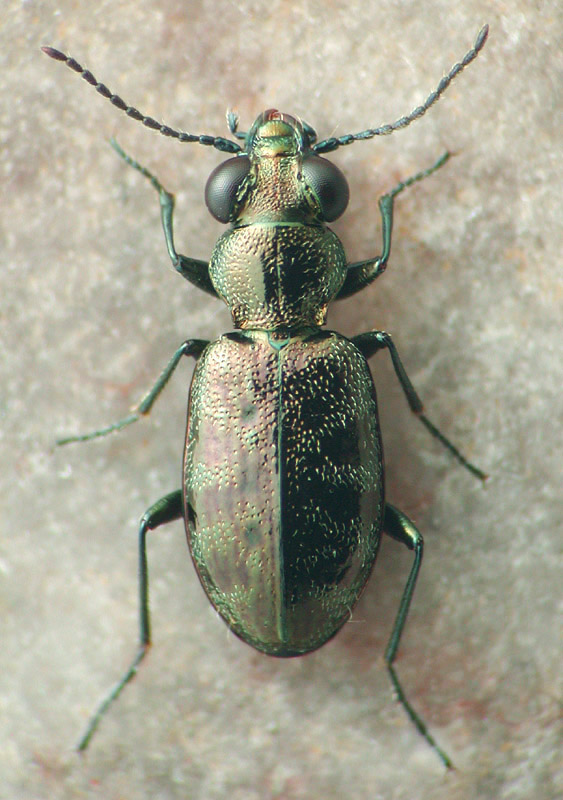
Chlaenius pimalicus (Carabidae: Harpalinae: Chlaeniini) is one of my favorite ground beetles from North America.  During my 17 years in Tucson, Arizona, I had very much wanted to find one in the field.  I didn’t manage until 2 months before I left Arizona.  One August day in 2009 we went down to Walker Canyon, and there, in an open grassland with large oak trees (pictured below), we found them in good numbers, running on the ground at night.  They may have been attracted to the area by our UV light.

Walker Canyon, AZ

Walker Canyon, AZ


Posted in Beetle of the Week | Leave a comment

Pretty heads and furrowed brows

What is it about Bembidion heads?  And, in particular, what is it with the heads of one subgroup of Bembidion, the Bembidion Series?  The Bembidion Series is a large clade of few hundred species, and represents perhaps a quarter of known Bembidion (that’s a bit of a guess – I’d have to add up the numbers to be sure).

Most Bembidion have heads with the dorsal surface relatively flat and simple, with two shallow grooves just inside the eyes, like thus:

zephyrumV100216Heada

Bembidion zephyrum

Within the Bembidion Series, some species have similar heads.  Others have more complexly textured heads, including wrinkled ones:

Bembidion (Notholopha) sp., Chile

Bembidion (Notholopha) sp., Chile

But within the Bembidion Series there has evolved, at least 5 times, heads with converging, deep grooves on the head.  Some of these are shown below.

Continue reading

Posted in Revising Bembidiina | Tagged , , | 4 Comments

Academic Beans: Citing Software

Scientific software is worthy of being cited on its own, without reference to a paper in which the software is described, and citations of the software should be tracked in the same way one would for a standard journal article.

Some authors of software feel they need to publish an article that describes the software, and they then ask users to cite the paper rather than the software.  This suggests that software is a second-class product, not worthy of being cited directly.  I understand the reason they do this: administrators, in counting beans, tend to value print publications more than other products, and some administrators might not even realize that Science Citation Index tabulates software citations directly.  However, by asking users to cite the print publication rather than the software directly, programmers are helping to devalue their own product.  If the software authors don’t fight for a belief in the value of software, who will?

Fortunately, many journals now allow one to cite software directly, and some have a special style for doing so.  However, some publishers (including two with whom I have dealt recently) require one to cite the “data accessed” if the software is downloaded from a website.  In so requiring, the publishers are confusing the means of obtaining the product from the product itself.  Most if not all software has a version number.  If the version number is included in the citation, why include the date the software was downloaded?   That’s like requiring us to include in citations of printed papers the date that the journal issue arrived in the mail, or the date a book arrived from Amazon.com.  How silly.

Posted in Academia | 2 Comments

BotW: Asaphidion yukonense

Asaphidion yukonense

Asaphidion yukonense

This lovely species occurs on damp soil in open areas around forests in northwestern North America, from Alberta to Alaska. Here’s what a typical habitat looks like:

Continue reading

Posted in Beetle of the Week | Tagged | Leave a comment

Morphological subtleties and the value of n > 1

Authors should consider illustrating two or more specimens of a species when trying to communicate the nature of some morphological trait in that species. Here’s why.

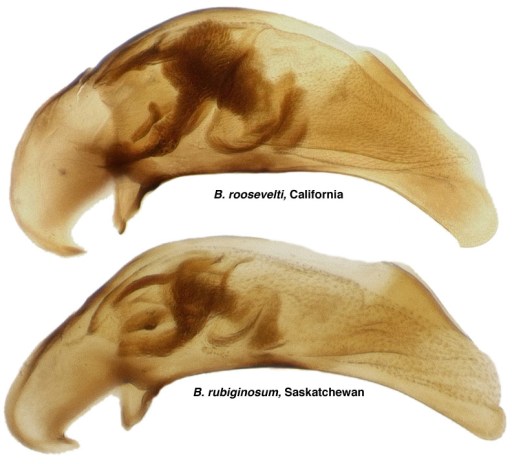
In illustrating morphological features in a publication, authors typically choose one specimen to image from each species.  For example, with male genitalia of Bembidion, one typically shows a plate containing a single genitalic image of each species.  Consider two species of Bembidion subgenus Semicampa from North America, B. roosevelti and B. rubiginosum.  These are small brown beetles, extremely similar to one another, which have been confused in the past.  Lindroth’s (1963) concept of B. roosevelti is a mixture of the two species; Bousquet and Webster (2006) speculated that they may be synonyms.  However, if you dissect genitalia, you will see subtle differences between the two species (see below).

DNA2780DNA2741

But of the many differences that can be seen in the two pictures above, which ones represent differences between species, and which are nothing but vagaries of the preparation, or lighting, or individual variation?  That is, what is signal and what is noise?

Continue reading

Posted in Revising Bembidiina, Scientific Illustrations, Taxonomic Process | Leave a comment

The mysterious Bembidion ulkei

In Carl Lindroth’s (1963) classic work on the Bembidiina of Canada and Alaska, he describes some species that do not occur in Canada or Alaska.  These species were always a source of some mystery to me when I was a teenager in Canada.  They were set in smaller print, too, as if Lindroth were whispering their details.  What were these curious foreigners?  Most of these species became familiar to me later, as I collected in the States, or as I examined material in various collections.  But one of those species, Bembidion ulkei Lindroth, continued to be a mystery. It was supposed to be similar to B. obscuripenne Blaisdell, which is found from the Sierra Nevada of California north into Washington state, and with which I was quite familiar.

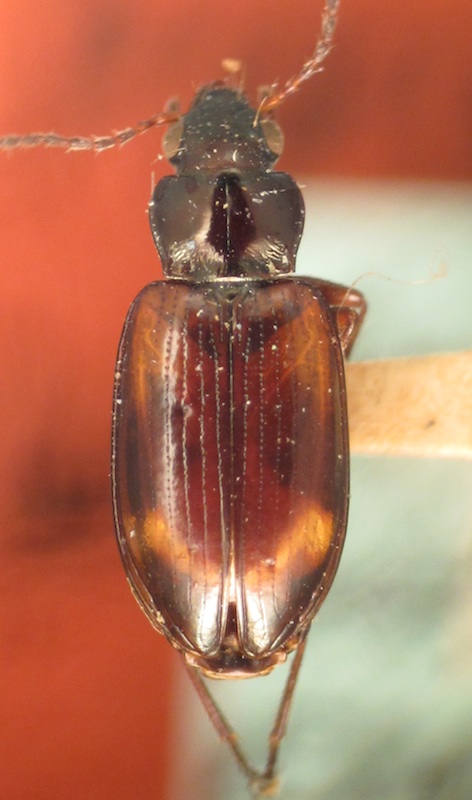
B. ulkei was only known from the original type series of six specimens, with the locality information being nothing more specific than “Nevada”.  I had never seen a specimen until last month, when I was visiting the Carnegie Museum (for an excellent carabidfest).  There I was very excited to see the type series; it made the species just a little bit less mysterious.  Here’s what one of the paratypes looks like:

ulkeiParatype

For my current revision of the Bembidiina of America North of Mexico, one of the puzzles for me has been how to acquire B. ulkei for DNA studies.  Did I need to tromp all around Nevada until I happened upon a locality?  What if they were endemic to the top of just one of the many mountain ranges? How long would it take to find them?

Continue reading

Posted in Revising Bembidiina, Taxonomic Process | Tagged | 1 Comment

Academic Beans: the strange world where 1 can equal 5

One of the interesting aspects of scientists in academia is that they love to quantify things wherever possible.  In some circumstances, this is a very good idea, as it can lead to greater precision and rigor.   But the increased rigor can come at the cost of decreased information content, and one can end up quantifying, very precisely, only minor themes of a larger story.  Such is the case in the very difficult enterprise of judging the value of one of your colleagues.
Continue reading

Posted in Academia | 1 Comment

Names in native languages

an unnamed species of Lionepha

an unnamed species of Lionepha

In an early post, I talked about how naming a species after the native people of an area should be done with caution, and ideally with permission.  While a name of a tribe is potentially offensive, I had thought that using a word from their language was not.  That is also a trend: to pick a word from the native language of an area, and use that to name a species.   I have a species of Lionepha to name from Marys Peak, Oregon, a species that lives in moss along the edges of waterfalls and nearby seeps.  It’s a nice species, quite distinctive, and so far only known from that one area.

Continue reading

Posted in Revising Bembidiina, Taxonomic Process | Tagged , | 6 Comments

BotW: Elaphrus

Elaphrus ruscarius

Elaphrus ruscarius

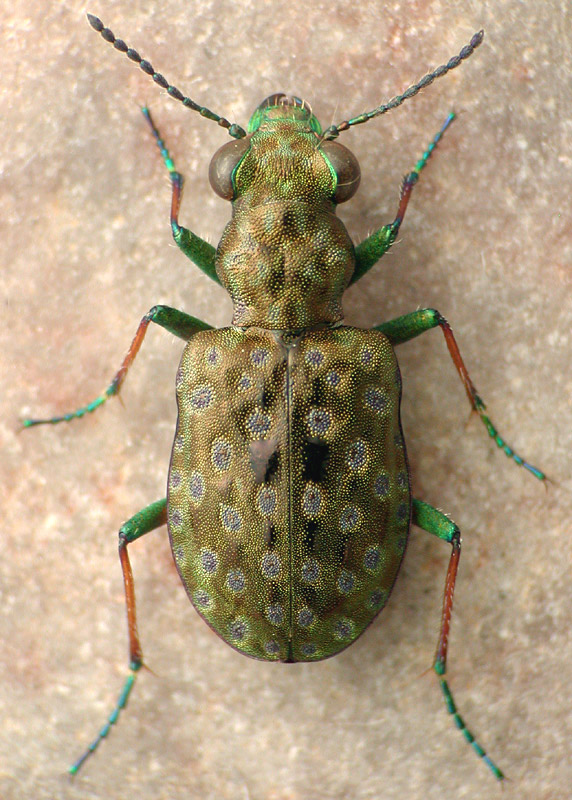
This beautiful ground beetle is from Hyco Creek in North Carolina.  It is not a Bembidion, but it is a carabid beetle, as are Bembidion. The genus Elaphrus has many spectacular species.  Here’s another species from the same habitat:

Continue reading

Posted in Beetle of the Week | 2 Comments

Ghost of a Massless Scalar Boson

ghostOfMSB

This is part of an illustration from “Gauge Theories of the Forces between Elementary Particles”, by Gerard ‘t Hooft, from Scientific American, published in 1980.  I think it quite astounding that one can convey the concept of the “ghost of a massless scalar boson” by a simple dotted circle.  This implies that one can illustrate a massless scalar boson (of the non-ghost variety) with a full circle (as dotting a line is clearly the indication of ghostiness), and, indeed, that full circle appears elsewhere on the page.  This implies to me that physicists are much more self-assured than biologists – I think most biologists would feel silly drawing a dotted circle and calling it the “ghost of a massless scalar boson”.  And, really, the name itself is so appealing – we biologists need to name things as evocatively as “massless scalar bosons”.  Maybe if we did, we too could acquire billions of dollars for our research.

Posted in Scientific Illustrations | Tagged , | 1 Comment